

Pharmaceutical supply chains do more than move materials between manufacturing sites and the marketplace. They help ensure patients continue receiving the medicines they depend on. When disruptions occur, whether from regulatory actions, geopolitical instability, natural disasters, transportation delays, or trade restrictions, the consequences extend beyond manufacturing schedules. Product availability, commercial continuity, and patient access can all be affected.
Supply chain resilience has become a strategic priority across the pharmaceutical industry. The COVID-19 pandemic exposed vulnerabilities throughout global manufacturing networks, prompting pharmaceutical companies to rethink how they source raw materials, manufacture active pharmaceutical ingredients (APIs), and prepare products for commercialization.
For API developers and drug manufacturers, the objective extends beyond controlling costs. Sponsors must ensure reliable product availability, maintain regulatory compliance, and protect years of development work from unexpected disruptions. As products move closer to commercialization, manufacturing continuity becomes just as important as commercial API manufacturing capacity.
Reshoring and dual-sourcing have emerged as practical strategies for strengthening API supply chains without sacrificing flexibility. Supported by an integrated global manufacturing network, these approaches help sponsors reduce risk while maintaining access to the manufacturing capabilities needed to bring therapies to market.
Why Pharmaceutical Companies Are Rebuilding Their API Supply Chains
Every stage of pharmaceutical manufacturing depends on a stable supply chain. Raw materials, intermediates, active pharmaceutical ingredients, and finished drug products all rely on suppliers, manufacturing facilities, logistics providers, and regulatory oversight working together.
When any part of that system is disrupted, product availability can be affected.
Manufacturing interruptions may result from FDA observations, natural disasters, transportation delays, geopolitical events, supplier shortages, or changing trade policies. A manufacturing strategy built around a single facility or supplier leaves little flexibility when these situations arise.
For commercial products, the consequences extend beyond operational delays. Interruptions can lead to drug shortages, delayed patient access, increased remediation costs, and supply uncertainty.
Building resilience into the API supply chain helps reduce these risks before they affect patients or commercial operations.
Reshoring and Dual-Sourcing Strengthen Business Continuity
Although often discussed together, reshoring and dual-sourcing address different aspects of supply chain resilience.
Reshoring focuses on increasing U.S. API manufacturing. Interest in domestic manufacturing has grown alongside government initiatives designed to strengthen national healthcare security and reduce dependence on overseas production for critical medicines.
Dual-sourcing complements this strategy by qualifying multiple manufacturing sites capable of producing the same API or intermediate. Rather than relying on a single source, sponsors establish redundant manufacturing capacity that can support commercial supply if one location experiences an unexpected interruption.
For example, if one manufacturing site temporarily pauses production following regulatory observations or remediation activities, production can continue at another qualified facility. Instead of waiting for a single site to return to full operation, sponsors can maintain product availability while corrective actions are completed.
The objective is not to replace existing supply chains. The objective is to strengthen them by building additional flexibility into commercial manufacturing strategies.
An Integrated Manufacturing Network Reduces Risk
Managing multiple manufacturing partners often introduces additional complexity. Different quality systems, operating procedures, communication processes, and technology platforms can create challenges during development and commercial production.
Olon addresses this differently.
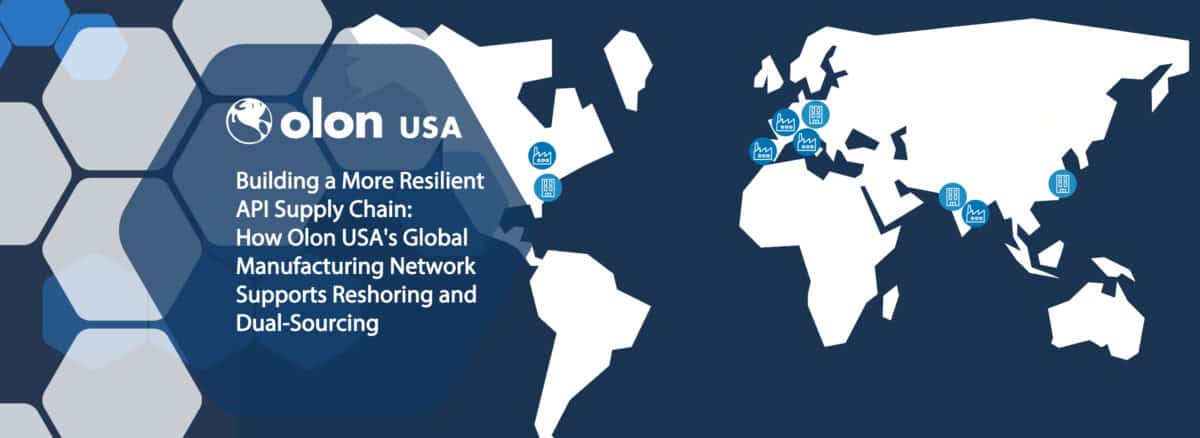
Olon USA operates as part of an integrated global manufacturing network that includes facilities across the United States, Europe, and other strategic regions. While each manufacturing site operates independently, the organization shares a global quality framework, standardized operating procedures, and scientific expertise across its network.
For sponsors, this creates greater consistency throughout development, manufacturing, quality oversight, and regulatory support. It also simplifies audits and communication because expectations remain consistent across Olon facilities.
Perhaps more importantly, it creates a foundation for reliable technology transfer.
Moving an API manufacturing process from one facility to another is often one of the highest-risk activities in commercial manufacturing. Within the Olon global manufacturing network, technology transfer is an established organizational capability. Technical teams collaborate across manufacturing sites to successfully transfer validated processes while minimizing disruption to sponsors. This integrated approach shifts much of the technical execution and coordination away from customers, reducing implementation risk while supporting long-term manufacturing continuity. Thus, a sponsor can have both a primary and secondary manufacturing site within the existing Olon network.
Flexible Manufacturing Models Support Reshoring Without Sacrificing Cost Efficiency
Reshoring does not require sponsors to relocate every manufacturing step to a single country.
Many pharmaceutical companies seek greater domestic manufacturing while remaining mindful of development and commercial costs. Olon’s global manufacturing network allows sponsors to balance both objectives.
One approach involves manufacturing starting materials or advanced intermediates at qualified facilities in Europe or India before completing the final GMP manufacturing steps in the United States. This model allows sponsors to leverage the efficiencies of Olon’s global manufacturing network while completing the final manufacturing activities domestically. The result is a practical approach to strengthening domestic production, supporting supply chain resilience, and managing overall manufacturing costs.
Rather than viewing reshoring as an all-or-nothing decision, sponsors can build manufacturing strategies that align with commercial objectives, regulatory expectations, and long-term supply continuity.
This flexibility is particularly valuable for emerging and mid-sized pharmaceutical companies seeking practical solutions that support both business growth and manufacturing security.
Supply Chain Resilience Begins Long Before Commercial Manufacturing
A resilient API supply chain starts during process development, not after commercial manufacturing begins.
Manufacturing strategy, raw material availability, supplier qualification, and process design all influence long-term supply reliability. Developing a comprehensive API development strategy early helps sponsors reduce technical risk, improve manufacturing flexibility, and prepare for commercial scale well before regulatory milestones approach.
Strategic planning is especially important during route scouting and route optimization, where early chemistry, sourcing decisions, and supplier qualification can significantly influence future supply chain resilience. Access to global sourcing resources and qualified suppliers for difficult-to-source materials provides additional flexibility as development programs mature and commercial manufacturing approaches.
As products approach Phase III development, sponsors should begin defining their long-term manufacturing strategy. Evaluating reshoring opportunities, dual-sourcing options, commercial manufacturing capacity, and technology transfer plans before regulatory submission provides greater flexibility while reducing future risk.
Building the Next Generation of Pharmaceutical Supply Chains
Pharmaceutical manufacturing is evolving toward more resilient, diversified supply chains rather than more centralized ones. Government initiatives supporting domestic API manufacturing, increased attention to critical medicine availability, and continued global uncertainty will likely accelerate adoption of reshoring and dual-sourcing strategies over the coming years.
The goal is not to replace global manufacturing networks. It is to strengthen them through geographic diversity, qualified manufacturing partners, and integrated commercial manufacturing capabilities.
Olon USA combines domestic API manufacturing with the expertise and infrastructure of Olon’s global manufacturing network to help sponsors build resilient supply chains that support development, commercialization, and long-term product availability. From process development and technology transfer to commercial API manufacturing and global sourcing, Olon provides the flexibility needed to navigate an increasingly complex pharmaceutical landscape.
Every development program has unique manufacturing, regulatory, and commercial objectives. Whether the goal is establishing a dual-sourcing strategy, increasing domestic manufacturing, or building a more resilient global API supply chain, Olon USA provides the expertise and manufacturing network to help sponsors prepare for long-term success. Contact the Olon USA team to start a conversation about your API manufacturing strategy and explore how an integrated global manufacturing network can strengthen supply chain resilience throughout your product’s lifecycle.